Welcome to the new issue of AIVisCity Weekly — a weekly briefing for those who want to understand how AI tools are changing the way customers discover businesses online.
In this week’s issue:
What’s Happening in AI Search — new signals that AI agents are becoming part of normal customer journeys, while most businesses still struggle to measure what AI visibility is actually doing.
Weekly Insight — why AI visibility cannot be measured like old SEO, what a better measurement goal looks like, and three practical ways small businesses can track real progress without expensive tools.
Try This Yourself — a simple 10-minute scorecard to check whether AI is helping the right customers find and act on your business.
Worth Reading — two useful deeper reads on where AI citations come from and what kinds of content shape AI answers.
AIVisCity Answers — Why Does AI Give Different Answers About My Business?
🔍 What’s Happening in AI Search
AI agents are moving closer to the buying journey
A new piece on agentic search argues that AI is increasingly comparing options and narrowing choices before a customer ever visits a website. For small businesses, visibility is not only about being mentioned. It is about being easy for AI to understand and trust. Practical implication: review whether your service pages, reviews, and profiles describe specific situations clearly enough for AI to compare you with alternatives.
Source: https://www.semrush.com/blog/what-is-agentic-search/
More businesses are appearing in AI answers than measuring them properly
A study found that 89% of brands now appear in AI-powered search results, but only 14% of marketers track AI and LLM citation visibility. A business can be visible in AI outputs and still have no idea whether that visibility is helping discovery or sales. Practical implication: start with a small tracking routine before paying for advanced reporting software. (Check our Weekly Insight below)
Source: https://www.globenewswire.com/news-release/2026/04/07/3269307/0/en/Only-14-of-Marketers-Track-AI-Search-Citations-Even-as-89-of-Brands-are-Already-Appearing-in-them.html
AI agents are becoming a measurable part of web traffic
AI agent requests had reached 88% of human organic search activity in a dataset report. Even if that ratio shifts, the pattern is clear: AI systems are becoming active participants in how customers evaluate businesses. Practical implication: do not treat AI visibility as a future experiment. Check it alongside search, reviews, and referrals.
Source: https://www.brightedge.com/news/press-releases/brightedge-data-ai-search-reaching-tipping-point-ai-agents-2026
🔮 Weekly Insight: How Should Small Businesses Measure AI Visibility Performance?
In last week issue, we touched on metrics like prompt demand, citation rates, and share of voice. They may look useful, but AI visibility cannot be measured as neatly as traditional SEO.
In SEO, you can track rankings, impressions, clicks, and search volume with reasonable consistency. AI search is exponentially more difficult. The same intent can appear in many conversational prompts, and answers change by platform, context, and follow-up questions. Even the same questions can yield very different answers due to the non-deterministic nature of AI.
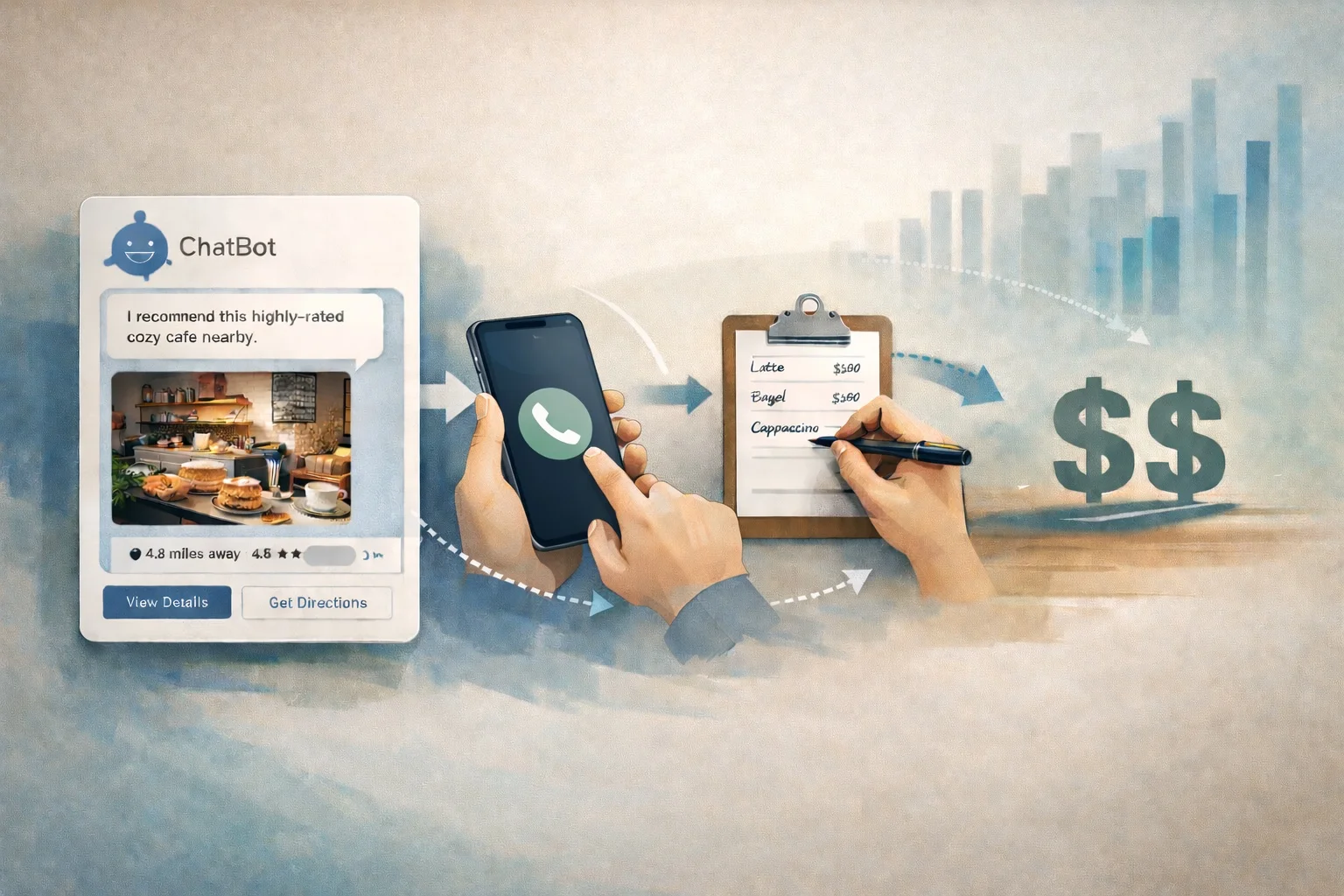
So how to measure AI Visibility performance? Our answer is to measure whether AI is helping the right customers find and choose you, not whether a dashboard says you were mentioned more often.
"If AI visibility cannot be tied to customer action, it is only noise."
That changes the goal. You do not need perfect metrics. You need enough evidence to see whether your business is becoming easier to discover, easier to trust, and easier to choose.
In practice, the most useful measurement is simple and close to the business outcome. Here we suggest three inexpensive ways that would do the job.
1. Track a small set of real customer prompts periodically.
Choose 5-10 questions a customer might genuinely ask, then check ChatGPT, Google AI results, or Perplexity weekly or monthly and log whether your business appears, how it is described, and whether a link is shown. If you are more comfortable with tech, build a simple automation that runs the same checks on a schedule. (You can also ask AI to build it for you)
2. Watch for AI-assisted traffic and enquiries.
Do not just look at total traffic. In analytics, check referral sources for domains such as `chatgpt.com`, `perplexity.ai`, `copilot.microsoft.com`, or `gemini.google.com`. If you have a contact form, add "ChatGPT or another AI tool" as an answer to "How did you hear about us?". You can also ask your new customers directly how they find you.
3. Track whether AI visibility improves your share of qualified enquiries.
Keep a simple monthly note of how many good-fit enquiries you receive for the services or customer types you most want. Then compare that with the improvements you make to your website, profiles, reviews, and prompt coverage.
This business-outcome check should sit above every other metrics. If better descriptions, reviews, and service pages lead to more qualified enquiries, your AI visibility is improving. If citations go up but lead quality does not improve, you may just be measuring activity instead of progress, or you are just attracting the wrong audience.
This matters because small businesses do not win by producing impressive dashboards. They win when AI helps the right person understand why they are a good fit. Measure that, and the rest becomes much clearer.
💻 Try This Yourself
Create a simple AI visibility audit you can repeat every week or month.
Use one page or one spreadsheet tab and include three checks: your prompt results, any AI-assisted traffic or enquiries you noticed, and the number of qualified enquiries you received. For the prompt check, write down five real customer questions and test them in one AI tool you care about most. For the enquiry check, note any visits from AI referral domains or customers who mentioned using AI. For the business outcome check, record whether the enquiries were from the kinds of customers and jobs you actually want.
By doing so, you are building a simple habit that helps you see whether AI is surfacing your business, describing it well, and bringing the right kind of customer closer to contact. Once you build up some historical data using this simple audit, you can use it to guide your focus and effort to improve AI Visibility.
📕 Worth Reading
If you're curious to look deeper into how AI search is changing the internet, these articles are worth a look.
AI Overviews are citing beyond Google's top 10 more often than many assume
Ahrefs updated its citation study in March 2026 and found that only around 38% of AI Overview citations also appear in the top 10 results. For small businesses, that reinforces an important point: strong traditional rankings help, but they do not fully explain AI visibility.
Read: https://ahrefs.com/blog/ai-overview-citations-top-10/
LinkedIn is becoming one of the sources AI systems use to explain brands
Semrush analysed 89,000 LinkedIn URLs cited in AI search and found that educational, original, consistently published content is cited far more than reshared or vague updates. For small businesses, that is a practical reminder that off-site clarity matters too.
Read: https://www.semrush.com/blog/linkedin-ai-visibility-study/
✅ AIVisCity Answers
Q: Why Does AI Give Different Answers About My Business?
A: When giving answers, AI assistant may pull from different sources, notice different details, or respond differently depending on how the question is asked.
Want a more detailed explanation? Check out here.
👋 Until Next Week
How are you seeing AI affect the way people search for businesses in your industry?
See you in the next issue of AIVisCity Weekly