Welcome to the new issue of AIVisCity Weekly — a weekly briefing for those who want to understand how AI tools are changing the way customers discover businesses online.
In this week’s issue:
What’s Happening in AI Search — new data on what earns citations, where Google is adding AI-driven actions, and why AI visits may matter more than their volume suggests.
Weekly Insight — a simple restaurant search example that shows the practical difference between SEO and AI Visibility (or Answering Engine Optimisation AEO).
Try This Yourself — a 10-minute comparison exercise using your own business category and location.
Worth Reading — two useful deeper reads on answer engine optimisation and the hidden fan-out queries behind AI search.
AIVisCity Answers — Should I List All My Services on One Page or Split Them into Separate Pages for AI Visibility?

🔍 What’s Happening in AI Search
ChatGPT is rewarding precision more than breadth
A new Search Engine Land summary of an AirOps study found that ChatGPT citations go most often to pages that rank well, match the query closely, and stay focused on one question. The practical implication: build pages around specific customer questions, not just large topic buckets (like those "ultimate guides" type of pages.)
Source: https://searchengineland.com/chatgpt-citations-ranking-precision-length-study-474538
AI visits may be fewer, but they are becoming more valuable
Adobe found AI-driven retail visits converted 42% better than non-AI traffic in March 2026. AI traffic may still be smaller, but the visitors can arrive with stronger purchase intent. Want to know why? read our Weekly Insights this week.
Source: https://searchengineland.com/ai-traffic-converts-better-us-retailers-report-474689
🔮 Weekly Insight: A Real Example of Why SEO Rankings and AI Answers Are Not the Same Thing?
In Issue 1, we explained the difference between SEO and AI Visibility (or Answering Engine Optimisation, AEO). Some readers asked for a real example so that they can understand it better. So this week let’s use one: A tourist trying to search for “best Italian restaurants in Tokyo.”
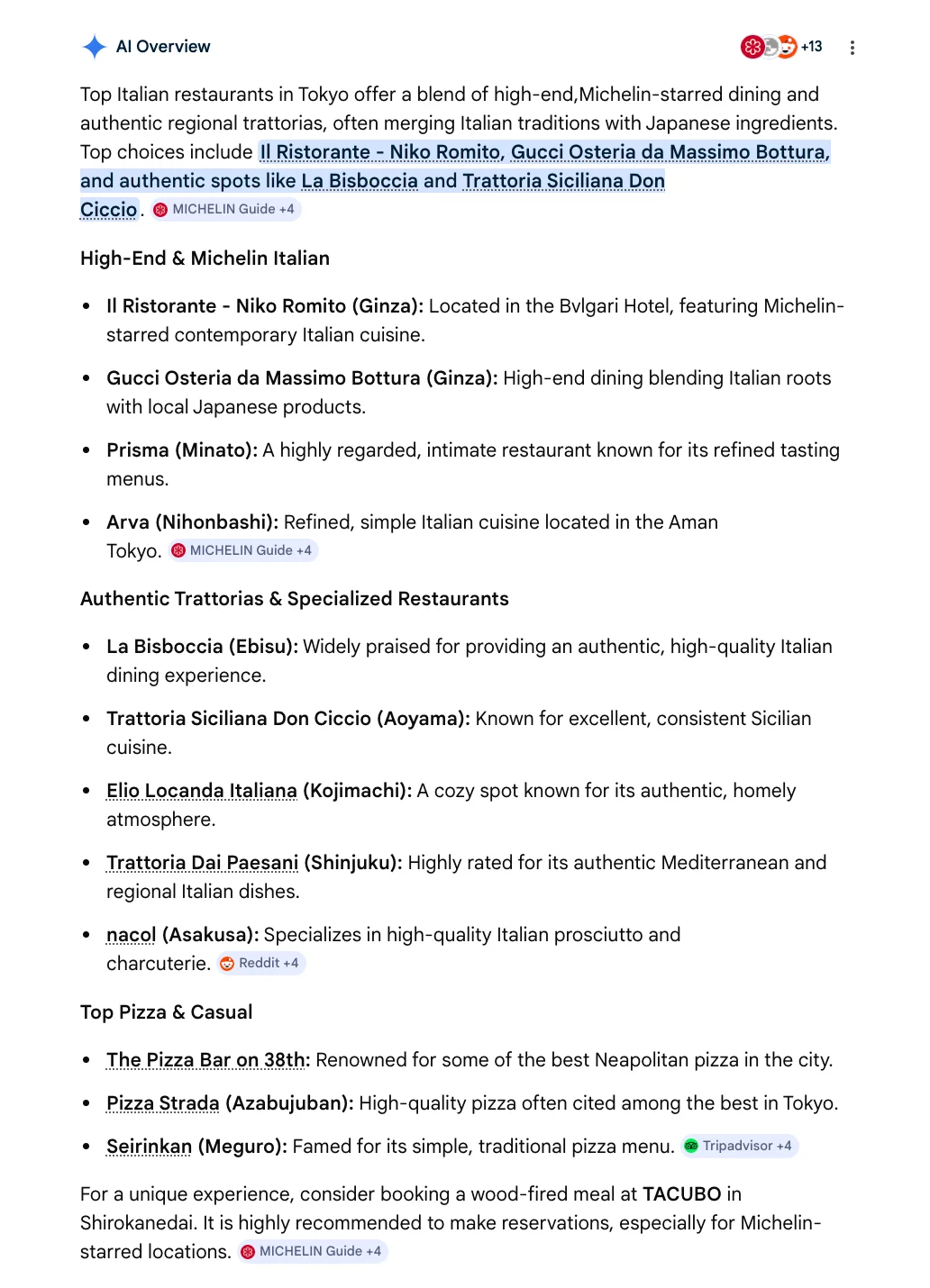
When she search with this query in Google. Google will return two parts of results to her: Google AI Overview follows by a list of regular search results. You can see real screen captures of the results below:
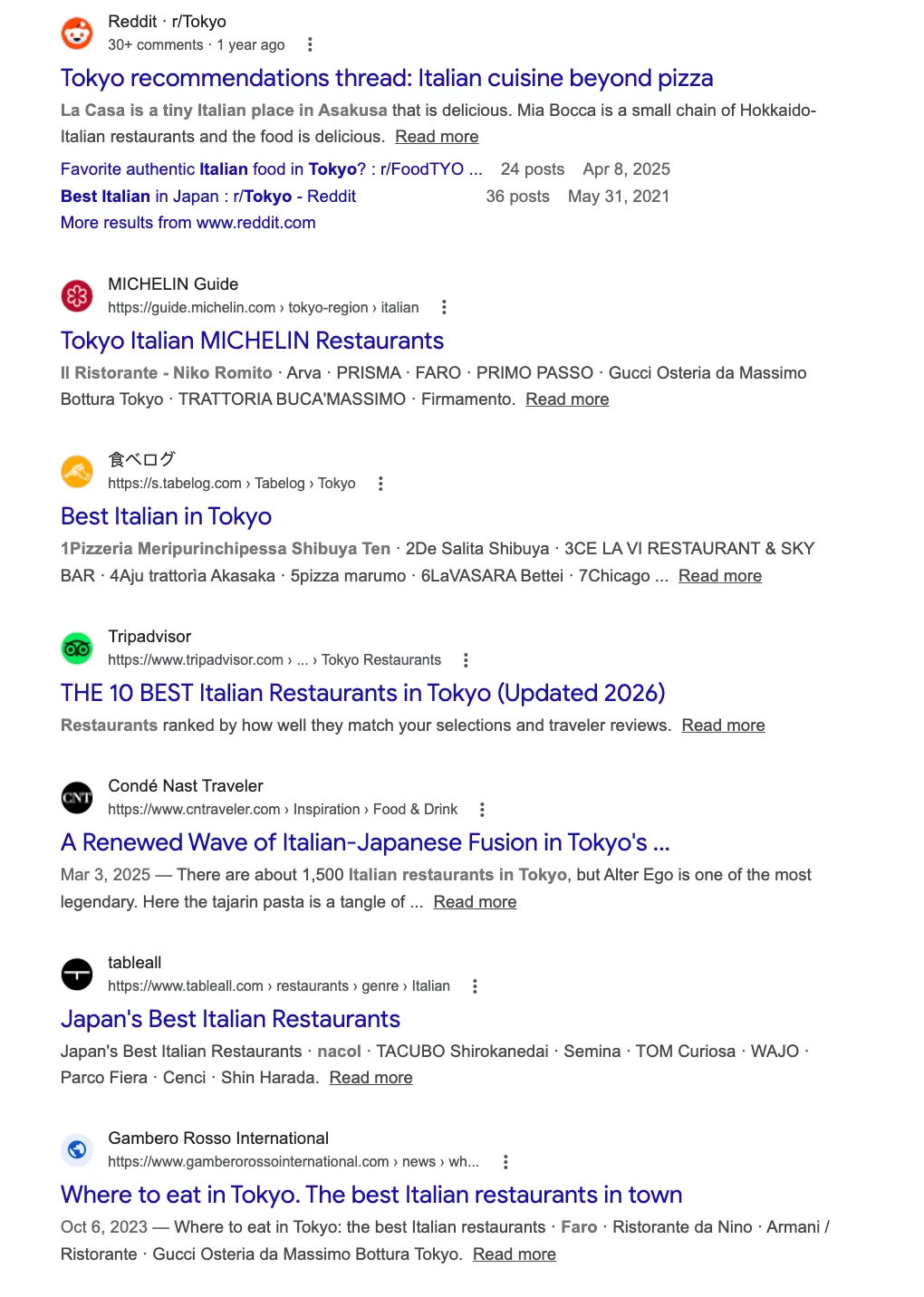
In the regular search results (left image), the first visible links are mostly publisher, review, and directory pages such as Reddit, Michelin Guide, Tabelog, and Tripadvisor. That is a common pattern for recommendation-type queries. Google often ranks “best” lists and review platforms before an individual business website.
Now look at the AI Overview (right image). It opens with a summary, groups recommendations into categories, and names restaurants like Il Ristorante - Niko Romito, La Bisboccia, and Pizza Strada.
That difference is the clearest way to understand SEO versus AEO. SEO is about helping your page rank in the list. AEO is about helping your business become part of the answer. “SEO gets you seen. AEO gets you chosen.”
The screenshots make another point clearly: the AI Overview citations are not the same thing as the top search results. Michelin Guide appears in both, but the Overview digests multiple sources and turns them into a shortlist of restaurants. In the normal results, Google ranks broadly useful pages. In the AI Overview, it selects sources that help it build a recommendation.
This also changes human behaviour. In the regular results, the searcher still has to open tabs and compare. In the AI Overview, Google has already narrowed the field. That means the cited sources shape the decision earlier, and the resulting lead often has better purchase intent because AI has helped her to make a more informed selection. That explains why leads coming from AI search normally have a high quality from that from organic search results.
For an individual business, this also shows where AI search becomes more valuable. It is hard to rank directly on Google for a query like “best italian restaurants in tokyo” because the results are dominated by list pages. But AI search can read those lists, combine them with reviews and other signals, and cite the business directly. That matters even more for narrower queries such as “best Italian restaurant in Tokyo for less than £20 per person.”
In practice, we often see three things behind those citations: strong third-party proof, clear business descriptions, and concrete facts that are easy to extract. For recommendation-style queries, third-party sites matter strongly because Google wants external validation.
In classic SEO for recommendation queries, getting into the right curated lists is already a meaningful win. In AI search, that is only the first step. To get picked from those lists, your business still needs clear descriptions, strong recommendations, and consistent citations across other sources. A clear business description does not only improve your chance of being cited. It also gives AI the language to highlight your strength.
The takeaway is simple: for recommendation queries, SEO helps you get into the list. AEO helps you get picked from it.
💻 Try This Yourself
Search one commercial question your customers might ask
Search a question about your business using the format “best [your service type] in [your town or city].”
Then compare the normal Google results with the AI answer above them. Do not just note who appears. Note what the AI-cited businesses or pages make easy to understand: who they serve, what they are known for, what proof they give, and what details help someone decide quickly.
Now check your own website or profile. Is that same information obvious in the first few seconds? If not, rewrite one sentence on your homepage or business profile so your best-fit customer and strongest proof are clearer.
📕 Worth Reading
If you're curious to look deeper into how AI search is changing the internet, these articles are worth a look.
A practical guide to what AEO changes
Semrush’s recent guide on answer engine optimisation explains the shift clearly: SEO is about ranking in results, while AEO is about being cited in AI-generated answers. For small businesses, it clarifies why mentions and proof matter more now.
Read: https://www.semrush.com/blog/answer-engine-optimization/
AI search often expands one prompt into many hidden searches
Ahrefs’ guide to query fan-out explains why one prompt can trigger many hidden sub-queries before an answer is generated. That matters because your business may be judged across related angles, not only the phrase typed by the customer.
Read: https://ahrefs.com/blog/query-fan-out/
✅ AIVisCity Answers
Q: Should I List All My Services on One Page or Split Them into Separate Pages?
A: Separate pages usually work better when your services are distinct. Clear service-specific pages give AI more precise information about what you offer, who it is for, and when your business is relevant to a particular question.
Want a more detailed explanation? Check out here.
👋 Until Next Week
How are you seeing AI affect the way people search for businesses in your industry?
See you in the next issue of AIVisCity Weekly