Welcome to the new issue of AIVisCity Weekly — a weekly briefing for those who want to understand how AI tools are changing the way customers discover businesses online.
In this week’s issue:
What’s Happening in AI Search — Google turns Search further toward AI agents, longer questions, and task-based discovery.
Weekly Insight — a short primer on the new Google AI Search capabilities from I/O 2026, what they mean for small business discovery, and what to do next.
Try This Yourself — use the Google I/O 2026 checklist to improve one product or service page.
Worth Reading — two deeper reads on AI Mode behaviour and practical AI visibility measurement.
AIVisCity Answers — How can I tell if AI search is actually bringing customers to my business?
🔍 What’s Happening in AI Search
Google is turning Search into a more agentic assistant
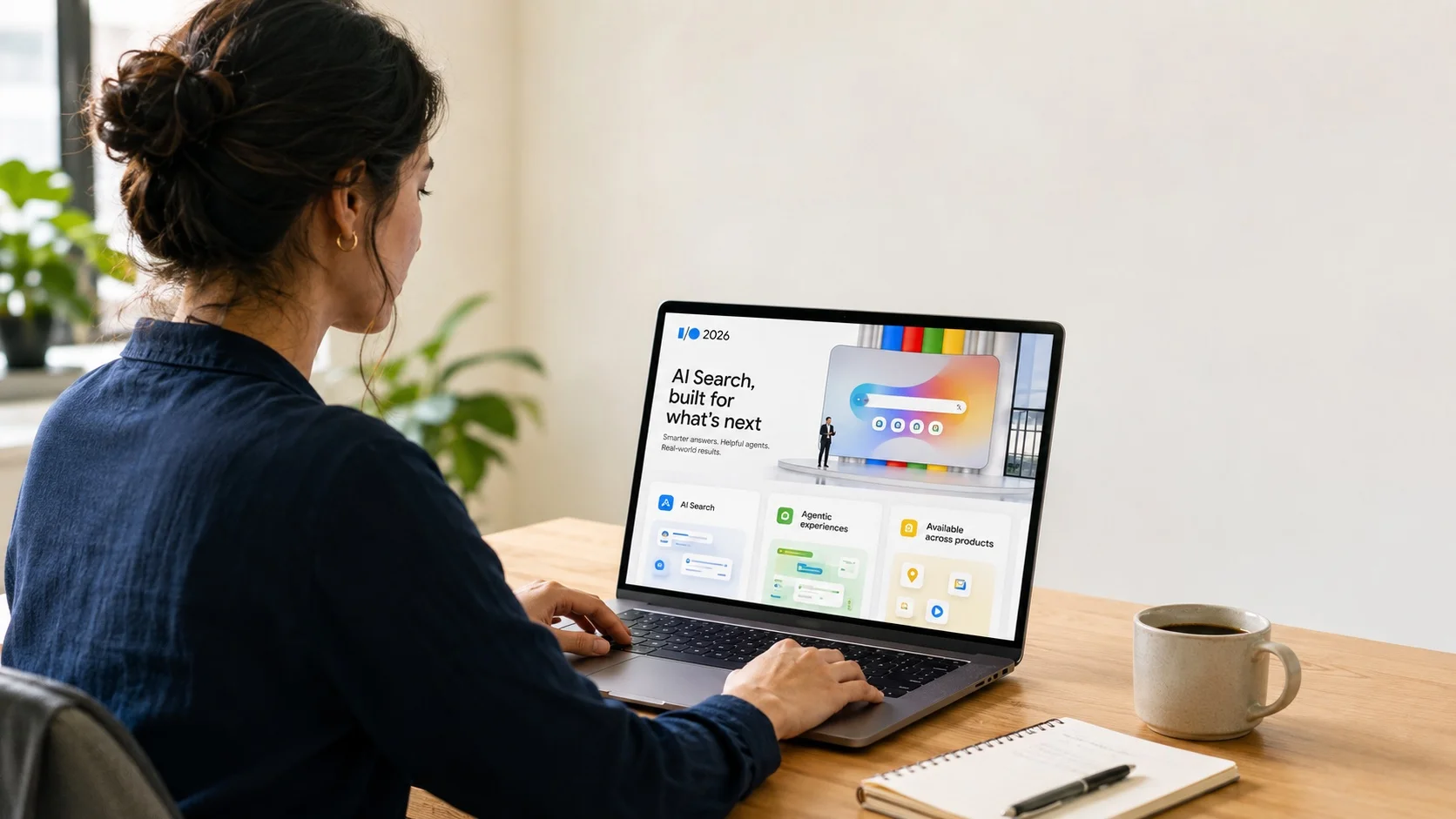
At Google I/O 2026, Google announced a more capable AI Mode, a redesigned AI-powered Search box, background information agents, agentic booking, and custom generated interfaces. For small businesses, the message is clear: customers may increasingly ask Google to plan, compare, monitor, and book, not just find a page. Practical implication: your website and profiles need clear operational details. Want to know how to deal with it? Read our Weekly Insight.
Source: https://blog.google/products-and-platforms/products/search/search-io-2026/?pubDate=20260520
AI Mode searches are longer and more decision-based
Search Engine Journal reported Google’s first AI Mode usage data: average AI Mode searches are three times longer than traditional searches, follow-up questions are rising, and planning queries are growing especially fast. Practical implication: create content for real decision questions, not only short keyword phrases.
Source: https://www.searchenginejournal.com/google-shares-first-ai-mode-usage-data-after-one-year/575443/
🔮 Weekly Insight: Google I/O 2026 and How Small Businesses Should React to AI Search
Google I/O 2026 made one thing obvious: Google Search is moving from “show me links” toward “help me get this done.”
For small businesses, the core idea is simple. AI Search needs facts it can use, not just copy it can read.
“Your business details are becoming action data.”
Let's look at what is/will be changed and more importantly, how you should deal with it.
1. AI Mode is built for longer questions
What changed: AI Mode is becoming more capable, so users can ask more detailed questions.
Impact: customers may move from “emergency plumber Bristol” to “who can fix a leaking pipe tonight in a rented flat and explain the likely call-out cost?”
Do this: add situational answers to service pages and FAQs. Mention problem type, customer type, location, price factors, and next step.
2. The Search box can handle richer input
What changed: Search can accept longer questions, images, files, videos, and Chrome tabs.
Impact: discovery may start from messy customer context, such as a broken item photo or a product screenshot. In practice, AI tools work better when pages describe visible problems and service boundaries.
Do this: add photos, examples, cases, and plain descriptions of what you can assess, repair, advise on, or sell.
3. AI Overviews can turn into follow-up journeys
What changed: users can continue from AI Overviews into AI Mode.
Impact: customers may compare and narrow options without restarting search.
Do this: write comparison-friendly content. Explain who it suits, price factors, timings, and what to prepare.
4. Information agents can monitor for users
What changed: Google introduced agents that can watch for matching information in the background.
Impact: stale information can make your business miss the moment when a customer is ready.
Do this: keep hours, seasonal services, availability, events, menus, stock, and offers current.
5. Search can help with booking and calling
What changed: Google says Search can pull pricing and availability together, and in some cases call businesses.
Impact: the easiest business to verify may win.
Do this: show booking links, service areas, response times, phone numbers, price ranges, and appointment details.
6. Universal Cart brings AI closer to purchase
What changed: Google is connecting shopping across Search, Gemini, YouTube and Gmail.
Impact: product visibility depends more on clean commerce data.
Do this: keep stock, delivery, returns, variants, compatibility, and product feeds accurate.
7. Results may become personalised and generated
What changed: Search may create personalised trackers, dashboards, or planning views.
Impact: your business may appear inside an AI-built interface, not a normal results page.
Do this: strengthen the facts AI can reuse: services, current data, comparisons, reviews, and direct paths to act.
The practical takeaway
The takeaway is not to chase every new AI feature. Start with the pages and profiles AI Search is most likely to read before recommending you.
Make your services specific, your availability current, your pricing cues visible, your proof easy to verify, and your next step obvious. That is how a small business becomes easier for AI Search to understand, compare, and recommend.
💻 Try This Yourself
Pick one product or service page on your website. Use the seven changes in this week’s insight as a quick checklist.
Can the page answer a longer customer question? Does it include examples, photos, or details for richer search input? Does it help people compare options? Are availability, booking, stock, price factors, and next steps clear?
Choose one weak area and improve it today. For example, add a “best for” section, update availability, explain price factors, or make the booking link easier to find.
Need more guidance? Check out Getting Your Business Found by AI, a practical, hands-on guide for small businesses navigating the new era of AI search, generative answers, and zero-click discovery.
📕 Worth Reading
If you're curious to look deeper into how AI search is changing the internet, these articles are worth a look.
AI visibility measurement needs different KPIs
Semrush explains why traffic alone is a weak AI search metric, because AI answers can influence customers without producing a website visit. Small businesses should track whether AI tools mention them accurately, not only whether analytics traffic rises.
Read: https://www.semrush.com/blog/measure-ai-visibility/
Reviews are becoming stronger AI discovery signals
TechRadar covered Trustpilot research suggesting review platforms are heavily cited in AI-generated answers. The study has a platform-specific angle, but the practical lesson is useful: fresh reviews, responses, and public trust signals help AI systems verify that a business is active and credible.
Read: https://www.techradar.com/pro/is-your-business-not-showing-up-in-ai-overviews-trustpilot-thinks-it-could-be-because-youre-not-doing-this-one-thing
✅ AIVisCity Answers
Q: How can I tell if AI search is actually bringing customers to my business?
A: You usually cannot measure AI search perfectly yet, but you can look for practical signs. Check website referrals, ask new enquiries how they found you, track calls and forms, and watch whether customers use phrases similar to AI-generated recommendations or summaries.
Want a more detailed explanation? Check out here.
👋 Until Next Week
How are you seeing AI affect the way people search for businesses in your industry?
See you in the next issue of AIVisCity Weekly