
AIVisCity Weekly #18: Use Bing’s AI Performance to Spot Where AI Understands Your Business
Welcome to the new issue of AIVisCity Weekly — a weekly briefing for those who want to understand how AI tools are changing the way customers discover businesses online.
In this week’s issue:
What’s Happening in AI Search — Bing adds AI citation reporting and Microsoft keeps moving Copilot into everyday interfaces.
Weekly Insight — how small businesses can use Bing Webmaster Tools’ AI Performance dashboard to monitor and improve AI Visibility without getting lost in analytics.
Try This Yourself — a quick way to turn one AI citation report into a useful website improvement.
Worth Reading — two deeper reads on user choice in AI search and how to measure AI visibility without mixing up different signals.
AIVisCity Answers — do prices on my website help AI tools answer customers?
🔍 What’s Happening in AI Search
Bing now gives site owners a clearer view of AI citations
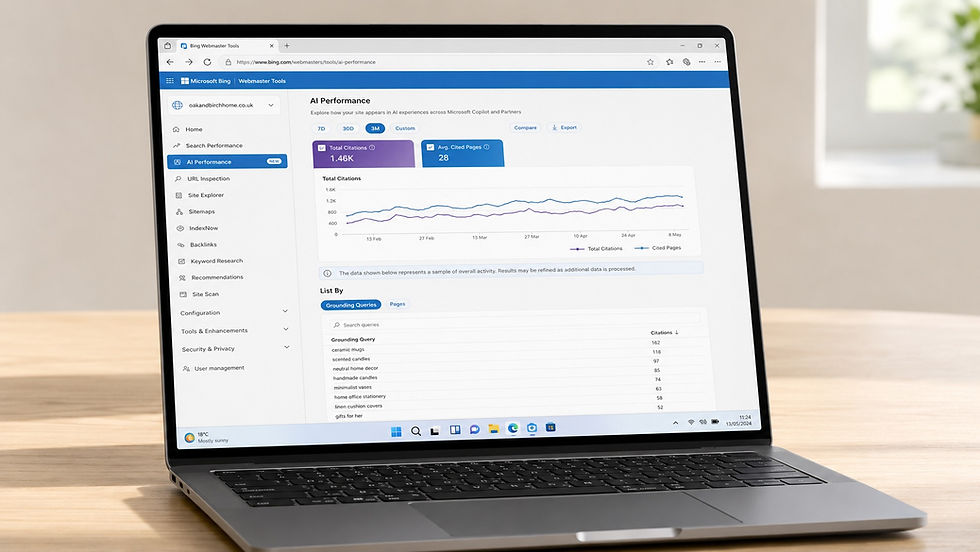
Bing Webmaster Tools’ AI Performance dashboard shows how a site’s pages are cited across Microsoft Copilot, Bing AI-generated summaries, and selected partner experiences. Practical implication: Owners now have a concrete place to check whether service pages, guides, or location pages are earning AI visibility. Want to know how to use it in practice? We've got you covered in this week's insights
Microsoft is still designing around Copilot-led discovery
Windows Central reports leaked material about Project Aion, an experimental Microsoft interface built around Copilot and web-based tasks. While this is a prototype and not a confirmed product launch, it shows how business discovery may increasingly happen through assistant-style prompts.
🔮 Weekly Insight: Use Bing’s AI Performance Report to Find Your AI Visibility Gaps
Most small businesses still talk about AI search as if it belongs mainly to Google or ChatGPT and forget about another important player: Microsoft Copilot and it's closely tied search infrastructure, Bing.
The recent release of AI Performance dashboard in Bing Webmaster Tool gives verified site owners a view of how their pages appear in AI-driven experiences across Microsoft Copilot, AI-generated summaries in Bing, and selected partner integrations. It may not be as sophisticated as other AI Visibility research products or platforms, but it's a good enough and simple tool for small businesses to check out.
The dashboard includes total citations, average cited pages, citation trends, grounding queries, and page-level activity. In plain English, you can see how often your site is cited, which pages are involved, and whether visibility is rising or falling.
For a small business, the value is in using the report to make better decisions.
First, identify your AI-visible pages. If blog posts are cited but service pages are not, AI may understand your advice better than your offer. Make service pages clearer, more specific, and easier to quote.
Second, use grounding queries to compare AI language with customer language. If Bing associates your page with unexpected phrases, check whether the page is too broad, missing a service detail, or attracting the wrong intent.
Third, use page-level activity to spot content gaps. A catering business might find that its wedding buffet page is cited, but its corporate lunch page is silent. That is a prompt to improve the weaker page with clearer packages, locations, dietary options, and proof.
Fourth, use trends as an early warning system. If citations drop after a redesign or page removal, check whether important information became harder to crawl or less explicit.
In practice, we often see small businesses focus on rankings while ignoring whether AI tools can actually reuse their pages. AI Performance shifts the question from “Did we publish content?” to “Is our content useful enough to be cited?”
The bonus is that good optimisation for Bing and Copilot is not a separate trick. The same principles help across AI tools: clear service pages, consistent facts, crawlable content, specific answers, and visible proof. Improve those signals for Microsoft’s AI search ecosystem, and you may also make your business easier for other AI assistants to understand and recommend.
💻 Try This Yourself
Open Bing Webmaster Tools and go to the AI Performance report for your site.
Choose one cited page and check the grounding queries linked to it. Ask: does this page clearly answer the kind of question Bing seems to associate with it?
If the answer is “not quite”, make one focused improvement. Add a clearer service sentence, a short FAQ, a location detail, a price or package clue, or one proof point such as a review or example.
This connects the report to action: you are improving the page so the next citation is more likely to represent your business accurately.
📕 Worth Reading
If you're curious to look deeper into how AI search is changing the internet, these articles are worth a look.
Bing is giving users more control over AI answers
Windows Central reports that Microsoft previewed a Bing extension that lets users toggle Copilot-style answers on or off. For small businesses, the lesson is measurement discipline: customers may move between AI answers and classic results, so watch both.
AI visibility tracking needs more than one metric
TechRadar’s guide separates three questions: whether a brand is mentioned or cited in AI answers, whether AI tools send traffic, and whether AI crawlers can access the site. Small businesses should avoid treating one prompt check as the picture.
✅ AIVisCity Answers
Q: Do prices on my website help AI tools answer customers?
A: Yes, they can. Clear prices, price ranges, or starting prices give AI tools more concrete information to use when customers ask about cost. This can help them describe your business more accurately, especially for service, product, and local comparison questions.
Want a more detailed explanation? Check out here.
👋 Until Next Week
If you find AIVisCity useful and want an easier way to keep up with practical AI Visibility updates for small businesses, you can use the button below to add AIVisCity as a Preferred Source in Google Search.

How are you seeing AI affect the way people search for businesses in your industry?
If you have noticed changes — or if you tried the quick check in this issue — we’d love to hear your observations. Feel free to share them in the comments.
See you in the next issue of AIVisCity Weekly


Comments